
Dresden, April 2025 – The Nexus has become one of the most cited frameworks in global sustainability talks—but what does it really mean in practice? A clear, actionable definition—one that’s grounded in experience and can unite funders, policymakers, researchers, and communities behind a common language—is still urgently needed.
That’s exactly what brought experts from across disciplines to a key session at the Dresden Nexus Conference (DNC 2025): “A Robust Definition of the Nexus – Learning from Resource Nexus and WEFE Applications.” The session created space for shared reflection on what the Nexus means—and what it takes to make it work.
A Definition Grounded in Participation and Practice
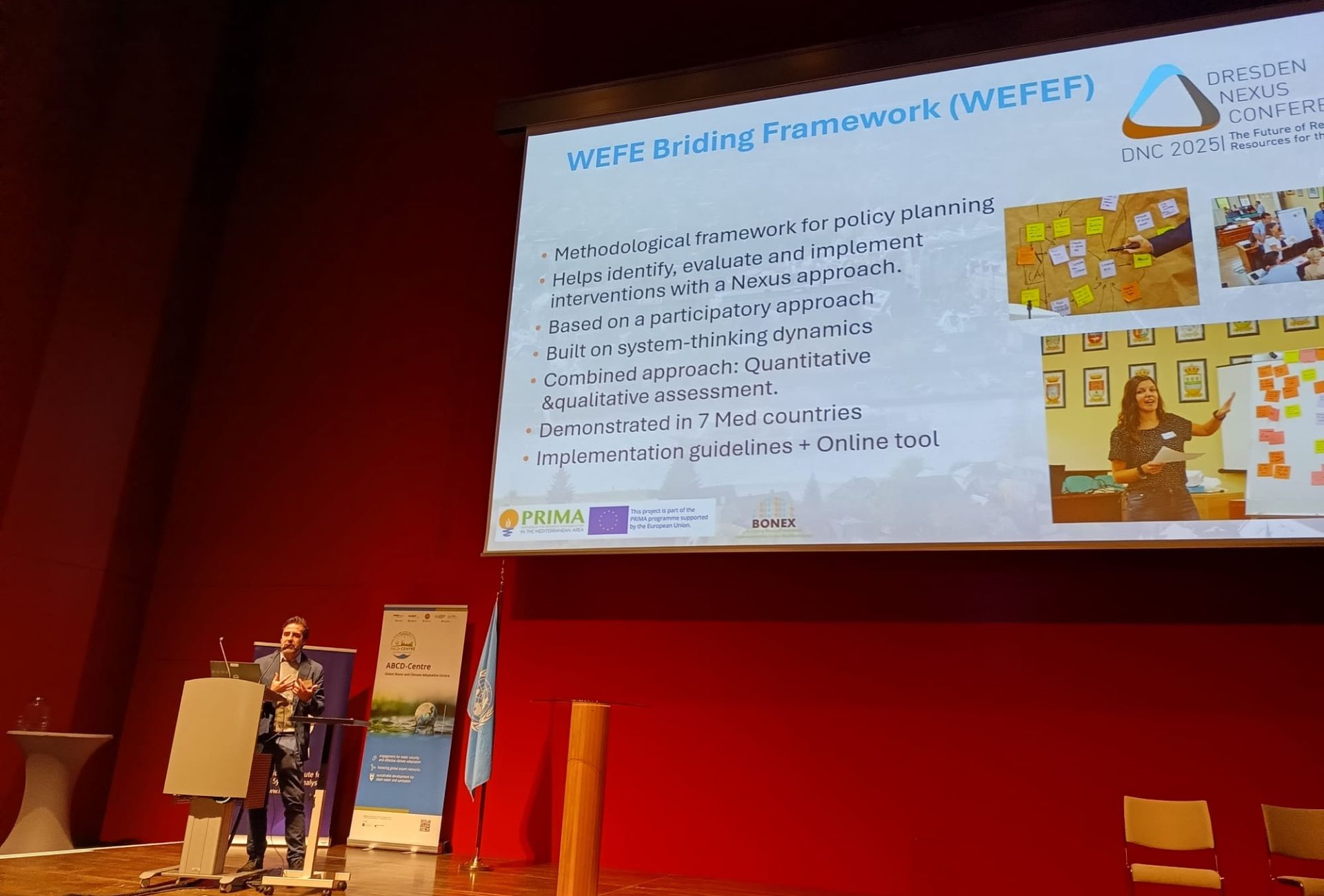
Representing the BONEX project, our coordinator Rafael Casielles from BIOAZUL delivered a definition with real-world traction. His proposal reframed the Nexus not just as a framework, but as a living policy process, grounded in participation, scientific evidence, and institutional coordination:
“The WEFE Nexus should be understood as a continuous policy process in which public participation plays a central role in shaping plans and setting priorities,” Casielles stated. “It is grounded in the fair and inclusive interaction of stakeholders across the water, energy, food, and ecosystem dimensions.”
He emphasized that a meaningful definition must be both scientifically sound and institutionally feasible:
“Scientific evidence must be placed at the core, supported by reliable data and sound indicators that transparently reflect impacts across all four pillars, while fully acknowledging the intrinsic value of ecosystems.”
His proposal underscored that effective Nexus practice requires more than technical tools or nominal collaboration:
“Genuine inter-institutional coordination must be operationalized through dedicated bodies, concrete action plans, and clearly allocated resources to ensure integrated and accountable implementation.”


Why Definitions Matter
From climate adaptation to food security, water governance to biodiversity protection, today’s biggest challenges are deeply interconnected. The Nexus offers a framework for navigating these links. But without a shared understanding of what Nexus practice actually entails, implementation remains fragmented.
At Dresden, the session emphasized that a strong definition is not just academic—it’s strategic. It enables funders to align programs, policymakers to break down silos, and communities to co-design solutions.
Institutionalization Is Key
The session also focused on the institutional dimensions of Nexus implementation. Participants—including the BONEX delegation—stressed the need for formal mechanisms: cross-sector bodies with real mandates, sustained funding, and legal authority. Without these, collaboration too often remains aspirational.
BONEX emphasized that embedding the Nexus into national strategies, legal frameworks, and investment plans is essential for translating integrated thinking into sustained, systemic action.
Looking Ahead
The Dresden session concluded not with a fixed definition, but with a shared commitment to co-develop principles, test ideas in practice, and build bridges between disciplines and sectors. With its experience in participatory water reuse planning and cross-sector governance, BONEX will continue to contribute to this evolving, collective effort.
As the WEFE Nexus moves from theory to application, Dresden 2025 marks a critical moment: where diverse actors begin aligning around a shared language—and a shared responsibility—to build more resilient, integrated futures.


